SpaceX Scores Breakthrough with Successful Starship Test Flight
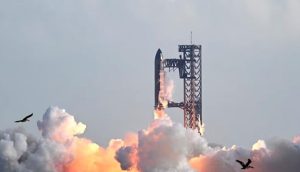
Texas — SpaceX’s Starship megarocket roared into the skies on its 10th test flight, offering the strongest sign yet that the company is making steady progress toward its ambitious goal of building a fully reusable spacecraft for missions to the Moon and Mars.
Towering 403 feet (123 meters), Starship is the most powerful rocket ever built and central to both Elon Musk’s dream of colonizing Mars and NASA’s Artemis program, which plans to return astronauts to the lunar surface by 2027.
The launch, from SpaceX’s Starbase in southern Texas, took place at 6:30 p.m. local time (2330 GMT) and was met with cheers from the engineering team, who have endured a string of fiery test failures in recent months.
A Key Step Forward
Shortly after liftoff, the rocket’s first-stage booster, known as Super Heavy, successfully splashed down in the Gulf of Mexico, producing a loud sonic boom. In a deliberate shift from previous attempts, SpaceX chose not to attempt a recovery with the launch tower’s massive “chopstick” arms. Instead, the team used the test to gather data on how the booster performs under unexpected conditions such as an engine cutout.
The focus then turned to the upper stage, also called Starship, which will eventually carry astronauts and cargo on deep-space missions. For the first time, the spacecraft deployed eight dummy Starlink satellites, using a robotic mechanism that gently released them into orbit. Cameras onboard captured the moment live, showcasing the spacecraft’s potential for future payload operations.
Lessons in Heat and Pressure
The test was not without its challenges. Some heat shield tiles fell away during reentry, and a small portion of a flap burned off as the vehicle was engulfed in plasma streaks of pink and purple.
But SpaceX officials emphasized that these issues were expected. “We’re really trying to push this Starship to its limits,” said communications manager Dan Huot, noting that engineers had intentionally removed some tiles to evaluate weaknesses in the design.
Overcoming Setbacks
The success was critical after a tough summer of failures. The last three test flights ended in explosions of the upper stage, including one that blew up over the Caribbean and another during a ground trial in June.
Despite setbacks, SpaceX has continued to lean on its “fail fast, learn fast” approach, which has already revolutionized spaceflight with the reusable Falcon rockets and Dragon capsules that ferry astronauts to the International Space Station. The company’s Starlink satellite network has also grown into a major global communications infrastructure, underlining its resilience.
The Road Ahead
Even with this milestone, significant challenges remain. Musk has described the development of a fully reusable heat shield as the hardest problem, pointing out that the Space Shuttle’s heat shield once required nine months of refurbishment between missions. SpaceX aims to make its heat shield fly-ready almost immediately after each launch — a game-changer for rapid reusability.
Another hurdle is the untested process of in-orbit refueling with super-cooled propellants, a critical capability for deep-space voyages.
Deadlines are looming. SpaceX must deliver a modified Starship as NASA’s lunar lander by 2027, while Musk has also pledged to send an uncrewed Starship to Mars as early as next year.
Why This Flight Matters
The tenth test may not have been flawless, but it demonstrated clear progress toward operational readiness. For SpaceX, it was more than just another experiment — it was a powerful answer to critics questioning whether the Mars rocket was slipping behind schedule.
As the largest, most ambitious spacecraft ever developed, Starship’s journey is still in its early stages. Yet with each test flight, SpaceX inches closer to turning science fiction into reality.
About the Author